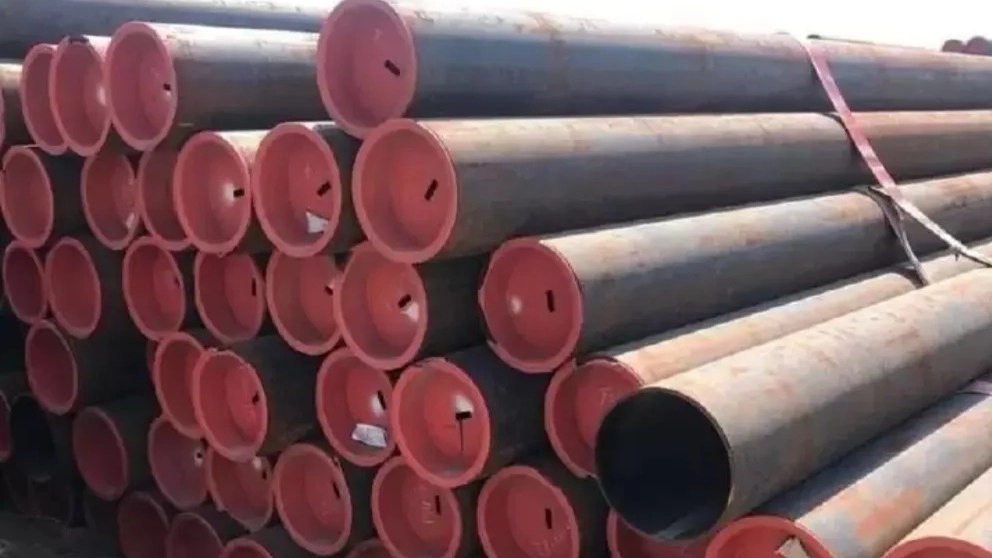
seamless pipes
To produce seamless pipes, metal billets are heated and shaped so that they become tubular in cross-section, and then by creating a hole inside them, it becomes a tube without any seams or welds on it. Does not exist. The word "seamless" means the absence of any seam or welding line.
Seamless pipes have various uses in oil and gas industries: Drilling pipes, casing and tubing Pipes for transporting liquids such as oil and gas, acids and steam Pipes used for oil and gas refining and related products
Direct Weld or Hidden Seam (ERW) Pipes
ERW pipes are available in sizes from 1.2 to 20 inches. The most common standard of carbon steel pipe is ASME A53 and the most common standard of stainless steel pipe is A312. In recent years, due to the advancement of technology in the field of welding, ERW pipes have become a good alternative to seamless pipes in terms of price and performance. Over the years, these new welding techniques have eroded the superiority of seamless pipes over ERW pipes and have made it possible to replace seamless pipes in at least some cases. Of course, seamless pipes are still superior to ERW due to their high resistance. ERW pipes are produced using coils in such a way that at first the coils are opened, straightened, cut, finally it becomes a tube shape and their edges are connected through electric welding. You can also read the spiral tube article.
LSAW (direct butt weld) pipes
Steel pipes are produced by cutting, bending and welding steel sheets. LSAW pipes in sizes between 16 and 24 inches compete with seamless pipes and ERW and take the lead in sizes 24 inches and above. hits. There are two types of LSAW pipes depending on the type of weld seam. The straight seam pipe that is formed is one or two straight welding lines and the spiral seam pipe. The difference between LSAW and DASW pipes is that in DSAW pipes, welding is done inside and outside the pipe at the seam, but in LSAW pipes, welding is done only on the outside of the pipe. The difference between LSAW and ERW pipes is that LSAW pipes are produced using steel sheets, but ERW pipes are produced using steel coils. To the management: Maysam Rafiei